ISBM Machine vs EBM Machine: Key Differences Explained
When packaging engineers evaluate blow molding technology for a new container programme, the choice between Injection Stretch Blow Molding (ISBM) and Extrusion Blow Molding (EBM) is one of the most consequential process decisions they will make. These two technologies both produce hollow plastic containers by inflating molten or semi-molten plastic with compressed air — but at the material science, engineering, and commercial level, they are profoundly different processes with distinct optimal application spaces.
Understanding their differences — not at a superficial level but in terms of the underlying physics, the achievable properties, and the economic model — is essential for making a confident technology selection decision. This guide provides that depth.
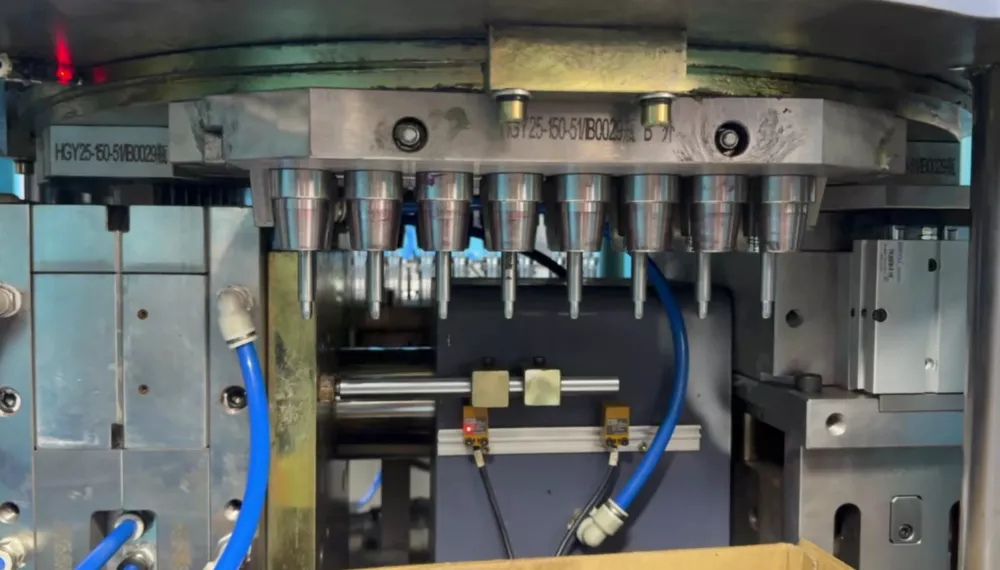
How EBM (Extrusion Blow Molding) Works
Extrusion blow molding begins with a continuous or intermittent extrusion of a molten plastic tube — called a parison — from a die head. The parison hangs vertically from the die. When it reaches the target length, a split mold closes around it, pinching and sealing both ends. Compressed air is then introduced through a blow pin at the top or bottom of the sealed parison, inflating it outward against the mold cavity walls. After cooling, the mold opens and the part is ejected — with flash trimming required to remove the pinched-off material at the top and bottom of the part.
- Extrude parison from die head
- Mold closes, pinches parison ends
- Blow pin inserted; air inflates parison
- Cool in mold
- Eject; trim flash from neck and base
- Inject resin into preform cavity (neck formed to final dimension)
- Condition preform temperature
- Stretch rod + air biaxially orients and expands preform
- Cool in blow mold
- Eject finished bottle (no flash; no trimming required)
The critical mechanical difference is that EBM uses only air pressure to expand the parison — there is no mechanical stretch rod, no preconditioning temperature window, and no biaxial orientation is deliberately induced. The parison is at or near melt temperature when blown, and chains deform without the controlled orientation that makes ISBM containers mechanically superior.
Side-by-Side Technical Comparison
| معيار | ISBM | EBM |
|---|---|---|
| Starting material form | Injection-molded preform | Continuously extruded parison |
| Molecular orientation | Biaxial (deliberate; controlled) | None to minimal (at melt temperature) |
| Neck finish | Injection-molded to final dim; no flash; tight tolerance ±0.1mm | Formed by pinch-off; can have parting line seam; wider tolerance ±0.3–0.5mm |
| Flash / trim required | None — clean net-shape part | Yes — neck and base flash must be trimmed; generates scrap |
| Wall thickness distribution | Controlled by preform design and orientation; uniform | Parison programming attempts to compensate; less uniform at complex geometries |
| Optical clarity (PET) | Crystal clear (biaxial orientation; thin oriented wall) | HDPE/PP: opaque or translucent. PET EBM possible but limited vs ISBM |
| Barrier properties | Enhanced 30–60% vs unoriented (O2, CO2) | Standard (unoriented); limited by material only |
| Material range | PET, PP, PETG (orientation-capable only) | HDPE, LDPE, PP, PVC, PC, co-extrusion (very wide range) |
| Integrated handles | Not practical (stretch ratio symmetry required) | Yes — EBM’s core strength for handled containers |
| Tooling cost | Higher per set (injection mold + blow mold) | Lower per set (blow mold only) |
| النفقات الرأسمالية للآلات | Higher (more complex system) | Lower for small systems; comparable at high cavitation |
| Best application zone | Pharma, cosmetics, food, precision packaging | HDPE jugs, handled containers, industrial packaging, multi-layer co-extrusion |
Where EBM Definitively Wins Over ISBM
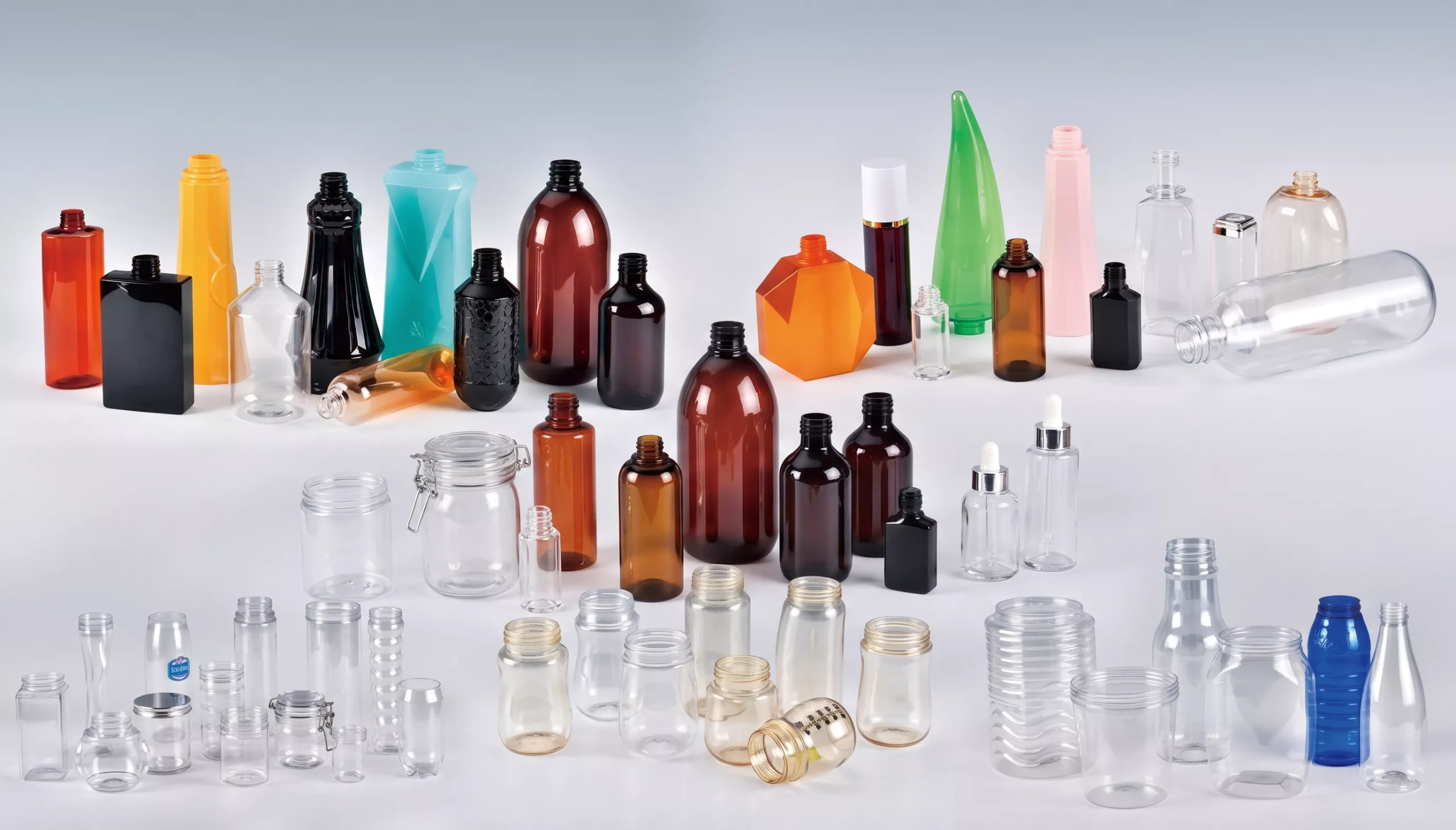
EBM is not an inferior technology — it is the dominant process for several very large packaging categories where ISBM cannot compete:
HDPE milk jugs, detergent jugs, juice containers with integrated handles — these define the EBM market. The handle is formed by the parison pinch-off process, impossible in ISBM where the preform must be symmetrical for biaxial stretching.
HDPE and LDPE cannot be stretch-blow molded — they lack the glass transition characteristics needed for orientation. For any application requiring HDPE (chemical resistance, high moisture barrier, FDA compliance for fatty foods), EBM is the only process.
EBM can co-extrude multiple polymer layers — e.g. HDPE/EVOH/HDPE for maximum oxygen barrier without ISBM’s orientation-derived barrier. This is preferred for agricultural chemicals, sauces, and other products where functional barrier layers are added rather than orientation-derived.
EBM is practical for containers from 5L to 1,000L. Industrial drums, chemical carboys, automotive fluid containers — these are exclusively EBM domain where ISBM cannot deliver the wall thickness control or scale required.
Where ISBM Definitively Wins Over EBM
Conversely, for any application where the container must be clear, lightweight, precisely dimensioned at the neck, and barrier-enhanced, ISBM is simply the better process — and often the only viable one. Our ISBM machine range covers the most commercially important formats in this category.
Child-resistant closures, pump necks, dropper interfaces — these require tolerances that EBM’s parison pinch-off neck cannot reliably achieve. ISBM injection-molded necks deliver this precision as a fundamental process characteristic.
PET EBM is technically possible but extremely rare — PET is difficult to extrude into a stable parison and the output quality is far below ISBM PET. Wherever crystal-clear PET is required, ISBM is the standard.
A 500ml ISBM PET water bottle can weigh as little as 8–10g. An equivalent EBM HDPE container would be significantly heavier. For sustainability-driven packaging lightweighting programmes, ISBM is the benchmark.
For oxygen-sensitive products (juice, wine, pharmaceutical liquids), ISBM PET’s orientation-enhanced barrier is the most cost-effective single-material solution — no coating, laminate, or co-extrusion required.
Decision Guide — ISBM or EBM for Your Application?
| If Your Container Needs… | Choose |
|---|---|
| Crystal-clear PET with precision neck finish | ISBM |
| Integrated handle (milk jug, detergent bottle) | EBM |
| Pharmaceutical or cosmetic precision packaging | ISBM |
| HDPE container (any size) | EBM |
| Oxygen-sensitive product (juice, pharma liquid) | ISBM (PET) |
| Industrial container above 5L | EBM |
| Lightweight 500ml–2L bottle (maximum material savings) | ISBM |
| Multi-layer barrier (EVOH core layer) | EBM (co-extrusion) |
| Premium cosmetic / fragrance packaging | ISBM (PETG) |
For containers that sit at the boundary between these two technologies — such as medium-clarity PP containers for daily chemical products, or hybrid applications requiring both handle and precision neck — a detailed application engineering review is the best path to a confident decision. Contact our team for an application review.
الأسئلة الشائعة
Can an EBM machine be retrofitted to produce ISBM-type oriented containers?
Is EBM or ISBM more energy-efficient per container produced?
I currently use EBM PP for my pharmaceutical product — should I switch to ISBM?
ISBM or EBM — Still Deciding?
Describe your container, product, volume, and current packaging and we will give you a clear recommendation with technical justification — no obligation.