Khuôn hũ miệng rộng cho máy ISBM: Những thách thức và giải pháp thiết kế
Wide-mouth jars — containers with neck finish diameters of 38mm and above — represent one of the most technically demanding mold design challenges in injection stretch blow molding. The geometry of a jar (short body relative to its diameter, large neck, broad shoulder) places every process parameter close to the edge of what ISBM can achieve: the axial stretch ratio is low (sometimes below 2×), the hoop stretch ratio is high (wide body relative to narrow preform), and the preform temperature distribution must be precisely sculpted to fill the complex shoulder geometry without thinning failures or material folding.
Wide-mouth ISBM jars are a particular strength of one-step ISBM technology — the conditioning station’s ability to independently control preform temperature zones gives one-step machines a decisive advantage over two-step reheat systems for this geometry. This article explains the mold design challenges specific to wide-mouth jars and the engineering solutions applied in successful commercial jar production programs.
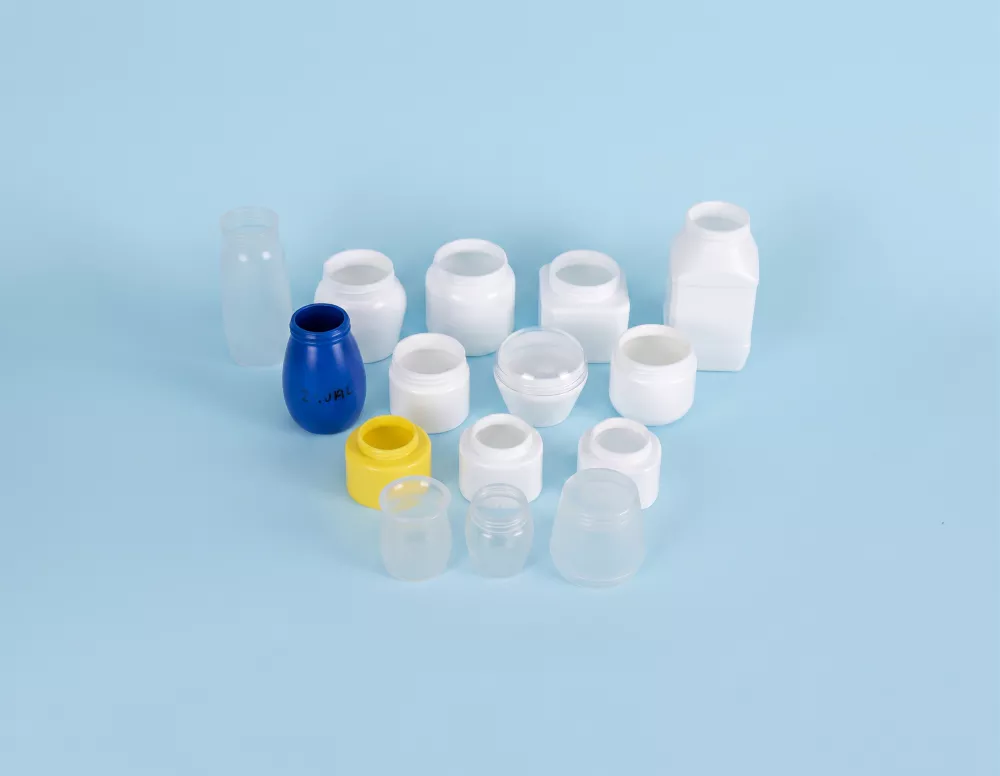
Why Wide-Mouth Jars Are Challenging for ISBM
The fundamental challenge of wide-mouth jar ISBM is the geometric conflict between what the process needs and what the jar requires:
| What ISBM Prefers | What Wide-Mouth Jars Require | The Conflict |
|---|---|---|
| ASR of 2.5–3.5× for good orientation | Short body → often ASR 1.5–2.5× | Under-orientation risk; weaker sidewall |
| Uniform round cross-section for symmetric blow | Large diameter → very high HSR at jar equator | Over-thinning at jar sidewall equator |
| Gradual shoulder taper for smooth material flow | Broad, nearly flat shoulder → very abrupt geometry transition | Material fold, thin spots, or incomplete shoulder fill |
| High HSR for good circumferential orientation and barrier | Wide neck already close to maximum preform diameter possible | Limited body diameter expansion available |
Preform Design Solutions for Wide-Mouth Jars

For wide-mouth jars, the preform body wall is tapered — thicker at the base (which forms the jar sidewall, stretched less) and thinner at the shoulder (which must travel the greater distance to form the broad jar shoulder). This taper compensates for the non-uniform stretch geometry inherent in the jar blow profile and helps achieve a more uniform final wall thickness.
Wide-mouth jar preforms benefit from a stepped (recessed) gate design that locates the gate vestige below the preform base plane. This provides additional clearance for the stretch rod tip, which in a jar preform operates at the maximum stroke limit for the short body geometry. Stepped gates also reduce gate-area stress concentration.
For jars with ASR below 2×, the stretch rod stroke is short but the pre-blow must begin very early — before the rod reaches mid-stroke — to pre-inflate the preform and allow the shoulder area to begin opening outward without the rod having to push material mechanically to the far shoulder.
Blow Mold Design Solutions for Wide-Mouth Jars
The blow mold for a wide-mouth jar must handle several geometric challenges that are less critical for standard narrow-body bottles:
The broad shoulder area of a jar is the last zone to receive expanding material. Air trapping in the shoulder corners is the most common wide-mouth jar defect. Vent slots must be concentrated at the shoulder radius, the shoulder-to-neck transition, and any shallow moulding features on the shoulder face. Sintered inserts at enclosed shoulder pockets are highly effective.
Wide-mouth jar neck finishes (38mm–120mm) are often large-format closures (continuous thread, snap-on, or lug) that are injection-formed to final dimension in the injection mold — they do not enter the blow mold. The blow mold must accommodate the transition from the base of the injection-moulded neck down to the jar shoulder accurately and without creating undercuts.
Jar bases are typically flat (for stacking stability) or slightly recessed. The flat base accumulates significant material at the centre (gate area receives lowest stretch). A beryllium copper base insert with high-flow cooling is strongly recommended to ensure the heavy gate area cools within the blow hold time and does not cause base distortion on ejection.
For round jars, the parting line is typically placed vertically through the jar sidewall at the widest diameter. For oval or rectangular jars, parting line placement must be carefully specified to avoid splitting through label panel areas or closure seating surfaces. A flash mark at the lid seating ledge is unacceptable and difficult to rectify without mold rework.
Conditioning Station Advantage for Jar Production
The one-step ISBM conditioning station is the key technical enabler for wide-mouth jar production. By providing independent zone-controlled heating of different preform body zones, the conditioning station allows the mold engineer and process engineer to sculpt the temperature profile of the preform before blowing:
- Upper body zone (forms jar shoulder): Heated to higher temperature for greater material mobility — allows the shoulder to flow outward into the broad jar shoulder geometry without tearing
- Mid and lower body zone (forms jar sidewall): Maintained at slightly lower temperature — slows radial expansion to maintain wall thickness in the jar equator zone
- Base/gate zone: Kept at minimum temperature for orientation — heavier section; slower to respond to heater
Two-step RSBM systems using linear IR ovens heat the preform from the outside only and cannot achieve the same zone-specific temperature control for non-standard preform proportions. This is why most commercial wide-mouth ISBM jar production runs on one-step machines.
For tooling design and machine specification for wide-mouth jar applications, contact our application engineering team. We have experience designing and producing wide-mouth ISBM jar tooling for food, pharmaceutical, cosmetic, and supplement applications across our ISBM machine range.

Câu hỏi thường gặp
What is the maximum neck diameter achievable on a one-step ISBM machine jar?
Can I produce a wide-mouth jar on a two-step ISBM system?
What closure types are compatible with ISBM wide-mouth jar neck finishes?
Developing a Wide-Mouth Jar on an ISBM Machine?
Share your jar drawing, material, closure type, and annual volume — our tooling engineers will propose a preform design and mold specification suited to your machine and application.