
What Materials Can Be Processed on an ISBM Machine?
The question of material compatibility is fundamental to any ISBM machine investment. Unlike extrusion blow molding which can process a wide variety of thermoplastics, injection stretch blow molding is limited to polymers that can both be injection-molded precisely and then biaxially oriented within a defined temperature window. Not every thermoplastic meets these dual requirements.
This guide covers in depth the three commercially dominant materials for ISBM — PET, PP, and PETG — plus emerging alternatives, explaining the polymer science behind their suitability, how their processing requirements differ, what containers they are best suited for, and the practical differences operators experience on the machine floor.
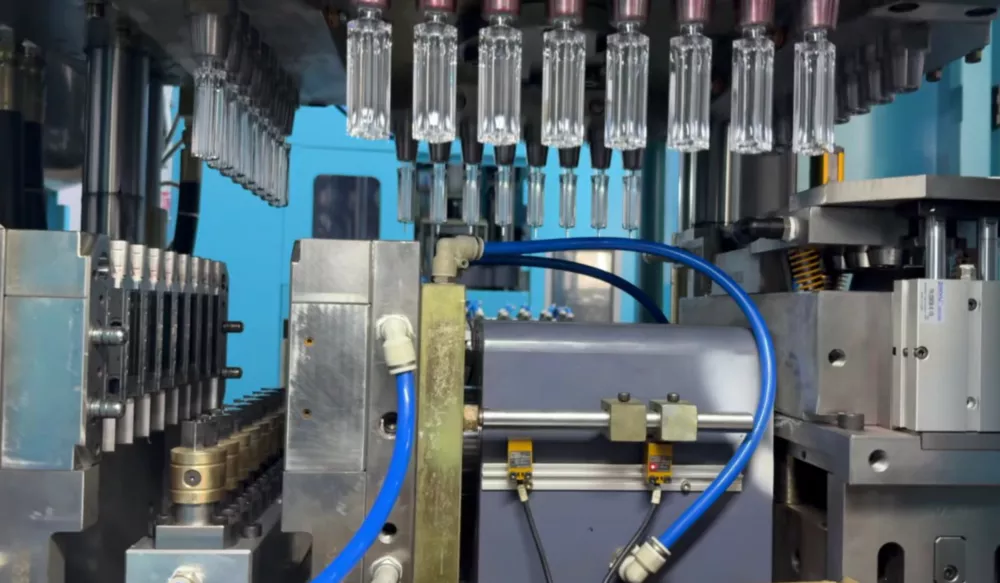
Why Not All Plastics Can Be Stretch-Blow Molded
Stretch blow molding requires a very specific rheological behaviour: the polymer must remain in a highly viscous, rubbery state at the stretch-blow temperature — mobile enough to deform under mechanical and pneumatic force, but resistant enough to maintain thickness distribution and not tear. This behaviour is only possible when the processing temperature is above the glass transition temperature (Tg) but below the crystallisation or melt temperature.
Additionally, for ISBM to deliver its defining advantage — biaxially oriented walls with enhanced properties — the polymer must be capable of strain-induced orientation (ideally including strain-induced crystallisation). Polymers that crystallise too rapidly, too slowly, or not at all in a useful way fail to develop the microstructure that makes ISBM containers superior to their injection-molded equivalents.
- Clear glass transition temperature (Tg) separating glassy state from rubbery state
- Sufficient melt strength in rubbery state to resist tearing during stretch
- Wide enough gap between Tg and Tm (or Tcc) to allow a practical process window
- Capacity for molecular orientation — chain alignment under deformation
- Good injection moldability — low injection viscosity at processing temp, good gate freezing
Material 1 — PET (Polyethylene Terephthalate)
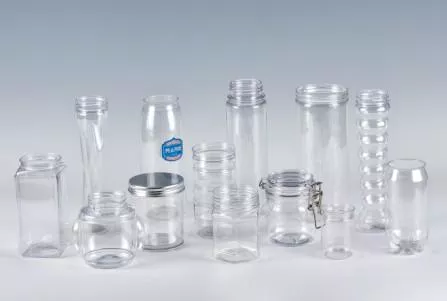
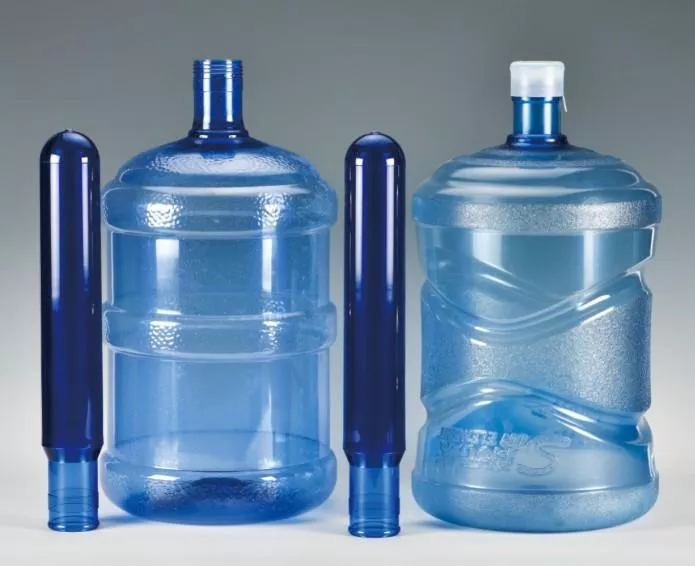
PET is the dominant material for ISBM by volume globally and the benchmark against which all other ISBM materials are measured. Its combination of a well-defined Tg (~75°C), highly controllable orientation window (90–105°C), and the remarkable phenomenon of strain-induced crystallinity make it uniquely suited to high-performance stretch-blow processing.
| PET Property | Value / Range | Implication for ISBM |
|---|---|---|
| Glass Transition Temperature | ~75°C | Wide orientation window above Tg; easily achieved in conditioning station |
| Optimal blow window | 90–105°C | 15–30°C window width — manageable, but requires stable conditioning control |
| Strain-induced crystallinity | Yes — strong SIC effect | Superior barrier + strength from crystalline microstructure |
| Moisture sensitivity | High (hygroscopic) | Mandatory drying to <50 ppm; dehumidifying dryer required |
| Injection temp range | 255–285°C | Avoid exceeding 295°C — rapid degradation (yellowing, AA generation) |
| Intrinsic Viscosity (IV) | 0.72–0.84 dL/g (ISBM grade) | Higher IV = stronger preform and bottle; lower IV = easier injection |
| Food contact | FDA, EU 10/2011, most global approvals | Confirm acetaldehyde specification for water/beverage contact |
PET grades for ISBM: Not all PET is the same. For ISBM, use copolymer PET specifically designed for injection stretch blow molding (sometimes designated ISBM grade or bottle grade). Key specifications: IV 0.76–0.82 dL/g; low diethylene glycol (DEG) content for good clarity; low acetaldehyde (AA) content or low AA generation catalyst for food/beverage contact; nucleating agent-free (nucleated PET crystallises too rapidly for ISBM).
Material 2 — PP (Polypropylene)
PP is the most technically challenging standard ISBM material. Unlike PET, PP is semi-crystalline with a melting point (approximately 145–165°C for random copolymers) and no equivalent of PET’s well-separated Tg/orientation window. The practical blow temperature window for PP is narrow — approximately 125–140°C — and requires very stable conditioning temperature control to avoid the two failure modes: too cold (poor stretch, high blow pressure needed, tear risk) and too hot (rapid cold crystallisation producing pearlescence/haze).
- Higher chemical resistance than PET — suitable for aggressive chemicals, ketones, aromatic solvents
- Higher temperature resistance — can be sterilised at 121°C (autoclave) for medical use
- Better moisture vapour barrier than PET (critical for hygroscopic pharma products)
- PP homopolymer and copolymer are olefin-based — better compatibility with fatty products
- Can be pigmented opaque without sacrificing mechanical performance
- Use random copolymer PP (rPP) — homopolymer PP is too crystalline, always shows pearlescence
- Nucleated grades crystallise too fast — avoid
- High-clarity rPP grades (e.g. Borpure from Borealis, PPH series from LyondellBasell) are preferred
- MFI 7–15 g/10min recommended for ISBM injection; too low = difficult injection; too high = poor preform strength
- Confirm pharma grade if for pharmaceutical containers (USP/EP compliant)
Material 3 — PETG (Glycol-Modified PET)
PETG (also written PET-G or GPET) is a copolymer of PET in which a portion of the ethylene glycol monomer is replaced by CHDM (cyclohexanedimethanol). This disrupts PET’s regular chain geometry, preventing crystallisation. The result is a permanently amorphous polymer with:
- Higher inherent clarity than PET (no crystalline haze at all)
- Glass-like optical quality — transmittance above 90%, haze below 1%
- Tg approximately 81°C — slightly higher than PET, providing better heat resistance in the final container
- No strain-induced crystallinity — orientation develops but is amorphous throughout
- Excellent chemical resistance to aromatic fragrances and essential oils
- Much higher density than PET (1.27 g/cm³) — heavier feel, premium perception
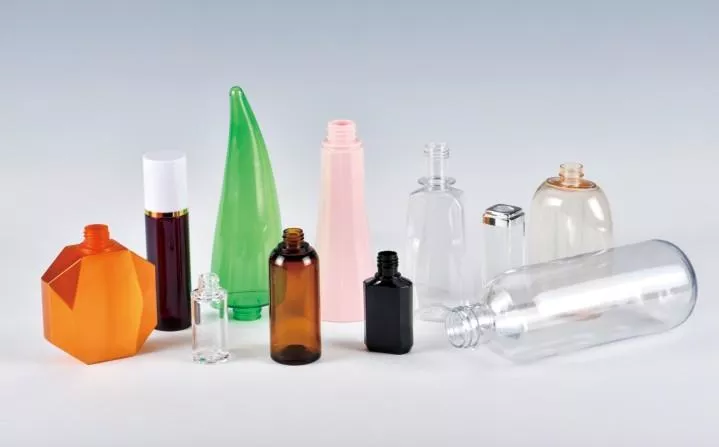
PETG is the dominant material for premium cosmetic packaging, particularly for fragrance (perfume) bottles, premium skin care, and any application where a glass-like aesthetic is required at plastic weight and cost. The inability of PETG to crystallise is a processing advantage (no cold crystallinity risk) but means it lacks the barrier improvement of PET; PETG bottles have essentially the same oxygen and CO2 permeability as unoriented PET.
Material Comparison Overview
| Property | پی ای ٹی | پی پی | پی ای ٹی جی |
|---|---|---|---|
| Optical clarity | Excellent (oriented) | Good (orientation-dependent; pearlescence risk) | Outstanding (amorphous — always clear) |
| O2 barrier | Good (orientation-enhanced) | Moderate | Standard (no orientation crystallinity) |
| Chemical resistance | Good (alcohols, dilute acids) | Excellent (wide chemical compatibility) | Good (better than PET for aromatic compounds) |
| Heat resistance | Standard (cold-fill only; hot-fill requires thermal treatment) | High (autoclavable up to 121°C) | Good (better than PET; not autoclavable) |
| Processing ease | Excellent (widest window, most forgiving) | Difficult (narrow window, pearlescence risk) | Easy (amorphous; no crystallinity risk) |
| Relative material cost | Low (commodity polymer) | Low (commodity polymer) | Medium-High (specialty copolymer) |
| Primary sector | Beverage, food, pharma | Pharma, food, medical | Cosmetics, fragrances, premium food |
Emerging and Specialty Materials
Beyond the three standard materials, ISBM research and limited production has been demonstrated with several emerging materials:
Up to 100% post-consumer recycled PET can be processed on ISBM machines, but requires careful IV management and may show more color variation. Growing commercial adoption due to sustainability mandates (EU PPWR regulation).
Bio-based polymer from furfural (plant-derived). Tg ~86°C, excellent O2 barrier (10× better than PET), CO2 barrier 3× better. Processing similar to PET. Niche and expensive but growing interest from beverage sector.
Biodegradable; Tg ~55–60°C. Can be ISBM processed but very narrow window and poor barrier versus PET. Limited adoption — heat resistance is a significant challenge in filled containers. Growing interest for bio-packaging but not mainstream ISBM material yet.
PET made from bio-derived ethylene glycol (sugarcane-derived MEG, up to 30% bio-based content). Drop-in replacement for fossil PET — identical processing, identical properties. Growing availability from major PET producers.
All ISBM machines in our range are validated for PET, PP, and PETG processing. For rPET, Bio-PET, and other specialty resins, contact us to discuss material compatibility and any required processing modifications.
اکثر پوچھے گئے سوالات
Can I switch between PET and PP on the same ISBM machine?
What is the difference between bottle-grade PET and general-purpose PET?
Can I use colour masterbatch in PET for ISBM?
Not Sure Which Material to Specify for Your ISBM Container?
Share your product contents, required shelf life, closure type, and target market — we will advise on material specification and machine setup for your application.