ISBM Machine Preventive Maintenance Schedule: Daily, Weekly, Monthly Checklist
Preventive maintenance is the single highest-return investment a production facility can make in its ISBM machine programme. The relationship between maintenance quality and machine uptime is direct and measurable: facilities running structured preventive maintenance programmes typically achieve OEE (Overall Equipment Effectiveness) scores 15–25% higher than comparable facilities running reactive maintenance only. In practical terms, this means significantly more bottles per shift from the same machine, with fewer quality holds, fewer emergency spare parts orders, and dramatically lower total cost of ownership over the machine life.
This article provides a practical, implementable preventive maintenance schedule for one-step ISBM machines, covering daily, weekly, monthly, and annual maintenance intervals. The schedule is designed to be adapted to specific machine models — not every check applies to every machine configuration — but covers the universal maintenance requirements common to all rotary-table one-step ISBM systems.
Why ISBM Machines Need Structured Preventive Maintenance
One-step ISBM machines are mechanically complex systems combining precision injection molding, servo or hydraulic actuation, high-pressure pneumatics (up to 40 bar), high-temperature processing (up to 295°C in the barrel), and chilled water cooling — all operating in tight synchronisation at cycle times of 8–18 seconds. This complexity means that degradation in any subsystem can cascade into process instability, product quality failures, and eventually unplanned machine downtime.
Emergency breakdown maintenance typically costs 3–5× more than planned preventive maintenance for the same repair, when unplanned downtime, rush shipping for spare parts, and production losses are factored in. A bearing that costs $80 to replace in a scheduled maintenance stop can cause $8,000+ in damage if it fails during production.
Many ISBM maintenance items affect product quality before they cause machine downtime. Worn stretch rod tips, degraded conditioning heater elements, and scaled cooling channels all cause progressive quality drift — increasing scrap rates, dimensional variation, and bottle property decline — that accumulates unseen until a customer complaint or quality audit triggers investigation.
For pharmaceutical and food-grade ISBM production, GMP regulations require documented preventive maintenance records. An audit finding of inadequate PM documentation can trigger product hold and regulatory action even if no product defect is identified. Structured PM records provide the compliance evidence needed.
Daily Maintenance Checks (per shift or per day)
| System | Check Item | Action if Out of Spec |
|---|---|---|
| Hot runner | Confirm all zone temperatures at setpoint; no active alarms | Investigate alarm before starting production |
| Hot runner | Inspect gate area for drool strings or residue from previous shutdown | Remove residue; adjust nozzle temp if recurring |
| Injection unit | Check barrel temperature zones all at setpoint; screw back-pressure stable | Allow thermal equilibration; check heater band function |
| Cooling system | Verify chilled water flow and temperature on all circuits (mold, blow mold, core rod) | Check chiller setpoint; check for blocked flow restrictors |
| Pneumatics | Check service unit (FRL) moisture trap — drain if >10% full; check oil level in lubricator | Drain trap; top up lubricator |
| High pressure air | Confirm HP air system pressure at setpoint; check for audible leaks | Locate and fix leaks; check compressor output |
| Conditioning station | Check all conditioning zone heaters on and at setpoint | Replace failed heater element; do not run with missing zone |
| Lubrication | Verify centralised lubrication system (if fitted) oil level; check pump cycle indicator | Top up oil; check pump and distribution lines |
| Safety | Test E-stop function; confirm safety door interlocks active; check guarding is in place | Do not operate machine with inoperative safety device |
| Material system | Check dryer temperature and dew point; confirm material level in hopper/drying silo | Do not process undried PET — moisture causes IV degradation and black specks |
Weekly Maintenance Tasks
| System | Task | Notes |
|---|---|---|
| Mold tooling | Clean blow mold vents; wipe preform cavity faces; inspect stretch rod tip for wear | Use brass brush on vents; lint-free cloth for cavities only |
| Drive system | Inspect servo drive indicator lights; check hydraulic oil level (if applicable); listen for unusual drive or bearing noise | Log any new noise for trend monitoring |
| Table rotation | Check table rotation smoothness; verify index position accuracy at each station | Position drift >0.1mm indicates worn index system |
| Stretch rod | Check rod for straightness; clean rod surface; verify rod tip seating | A bent rod causes asymmetric wall distribution — replace immediately |
| Pneumatic valves | Listen for air valve chatter or delayed response; check solenoid indicator lights on valve bank | Sluggish valves cause timing drift and blow defects |
| Hot runner | Verify zone temperature accuracy against independent thermocouple; inspect nozzle connections for leakage | Zone deviation >3°C from setpoint — recalibrate or replace thermocouple |
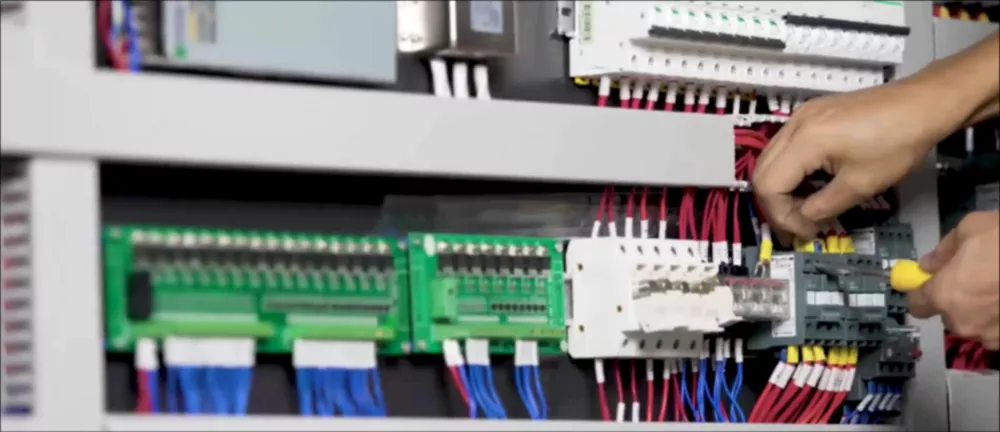
| Electrical cabinet | Check cabinet cooling fan operation; inspect for dust accumulation on drive boards; verify no active fault lights | Dust on drive boards causes overheating and premature failure |
Monthly Maintenance Tasks
| System | Task | Notes |
|---|---|---|
| Cooling system | Descale mold cooling channels with circulated acid solution; measure delta-T before and after to verify improvement | Use citric acid solution at manufacturer-recommended concentration |
| Mold guide pins | Clean and lubricate all mold guide pins and bushings; check for wear | Use food-grade lubricant if running food/pharma applications |
| Hydraulic system | Check hydraulic oil condition (colour, clarity); check hydraulic filter differential pressure indicator | Replace filter element if differential pressure lamp is lit |
| Barrel and screw | Check screw retraction consistency (shot volume stability); inspect hopper throat for bridging | Inconsistent shot volume indicates screw wear or check valve degradation |
| Dryer | Check and replace desiccant if dew point has risen above -20°C; clean dryer filter | PET must be dried to <50 ppm moisture — verify with moisture analyser |
| Conditioning heaters | Measure actual heater element surface temperature with pyrometer; compare to zone setpoints | Elements degraded >15% below setpoint surface temperature should be replaced |
Annual / Major Service
Annual maintenance should be scheduled as a planned production shutdown of 2–4 days, coordinated with production planning to minimise output impact. Tasks include:
- Full mold strip-down: Remove all mold components; dimensional audit of critical features; polish preform and blow mold cavities; replace stretch rod tip and check valve seat; replace core rod if chrome wear is evident
- Hydraulic oil change: Drain and refill hydraulic system with fresh oil of specified grade; replace all hydraulic filter elements; check and record system pressure at all rated circuits
- Screw and barrel inspection: Remove screw; measure screw OD and barrel ID for wear; replace check valve assembly as preventive action; inspect screw for wear or corrosion
- Hot runner major service: Disassemble manifold and nozzles; clean runner channels; replace all heater elements and thermocouples; re-verify runner balance; replace gate tips
- Electrical inspection: Tighten all electrical connections in cabinet and field wiring; test all safety circuits; verify servo drive encoder calibration; update machine software if firmware updates available
- Lubrication system: Replace all centralised lubrication system oil; clean distribution lines; check and re-set dispense volumes for all lube points
Our service engineers can perform annual maintenance on all ISBM machines we supply. Contact us to schedule an annual service visit or to discuss a maintenance contract.
Frequently Asked Questions
What spare parts should I keep in stock for an ISBM machine?
How do I document ISBM machine maintenance for GMP compliance?
Should I run maintenance checks during production or only during scheduled downtime?
Looking for a Maintenance Contract for Your ISBM Machine?
We offer annual service contracts covering scheduled preventive maintenance visits, spare parts supply, remote technical support, and emergency response for all machines in our range.