ISBM vs IBM Machine — What Is the Difference and When to Choose Each?
Two technologies dominate the production of injection-molded plastic containers with precision neck finishes: Injection Stretch Blow Molding (ISBM) and Injection Blow Molding (IBM). Both processes begin with an injection-molded preform or parison, and both deliver superior neck precision versus extrusion blow molding — but their underlying mechanisms, property outputs, and optimal application profiles are distinctly different.
Choosing the wrong process for a packaging application means either over-engineering (paying for ISBM orientation when IBM would deliver sufficient performance at lower cost) or under-engineering (using IBM when the product genuinely requires the barrier and strength of biaxially oriented ISBM containers). This guide provides the technical framework to make the right choice.
How IBM (Injection Blow Molding) Works
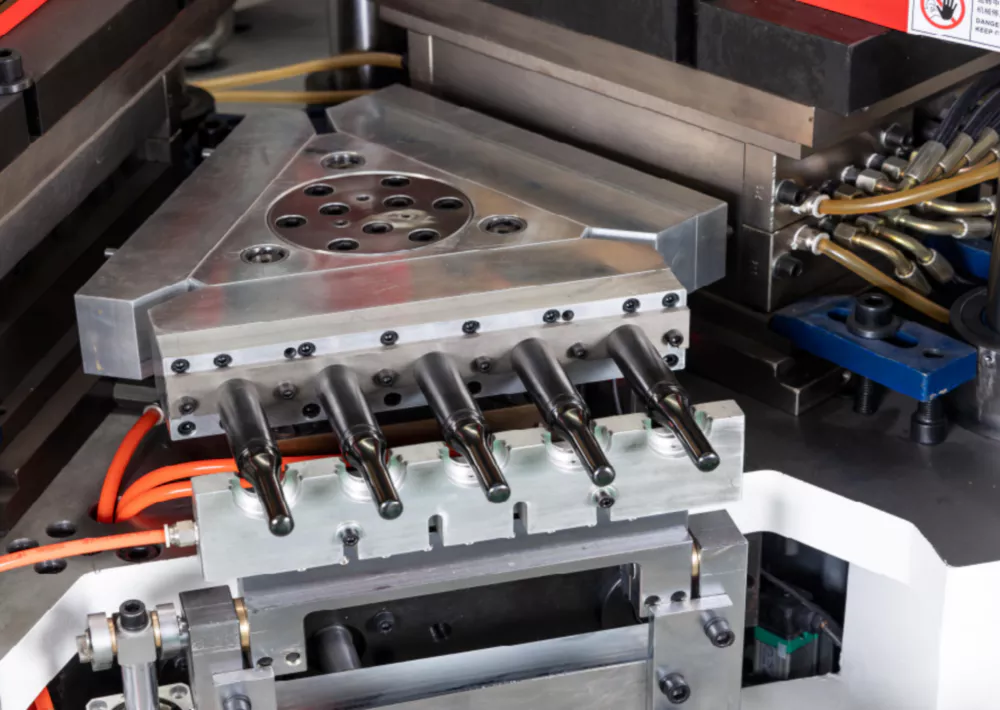
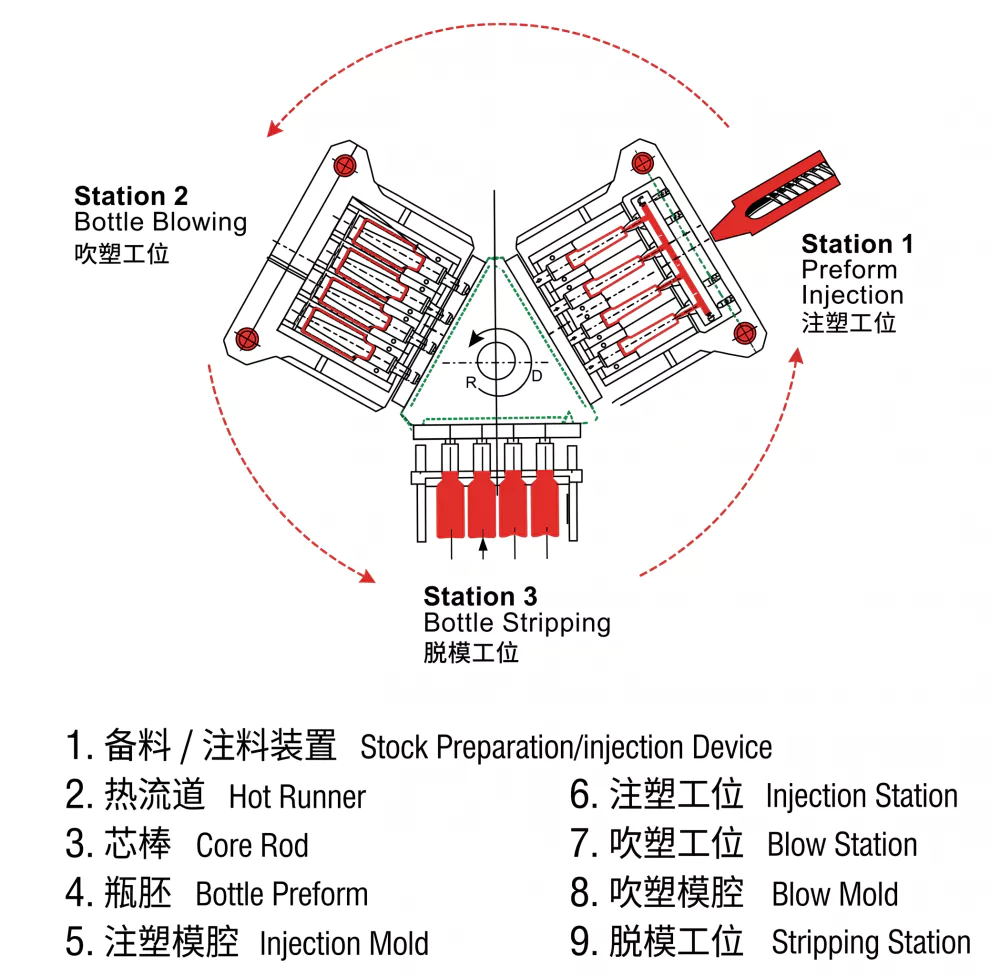
In a conventional IBM machine, the process follows three stations on a rotating table — typically 3 stations rather than 4 (no separate conditioning station is needed):
The critical distinction is what is absent in IBM: there is no mechanical stretch rod in the blow station. The parison is simply inflated by compressed air. This means:
- No significant axial stretching — chains are not aligned in the machine direction
- Limited radial orientation only (from the hoop expansion by air)
- No strain-induced crystallinity in PET (or it is minimal and uncontrolled)
- The parison is blown at or near melt temperature — not in a cold orientation window
The result is a container with essentially isotropic (non-oriented) properties — useful, but without the property multipliers that biaxial orientation delivers. IBM is best understood as a precision alternative to EBM for small-volume, high-neck-accuracy containers where orientation is not required.
ISBM vs IBM — Direct Technical Comparison
| Criterion | آی اس بی ام | آیبیام |
|---|---|---|
| Process stations | 4 (injection, conditioning, stretch-blow, eject) | 3 (injection, blow, eject) |
| Stretch rod used? | Yes — mechanical axial + air radial | No — air only |
| Molecular orientation | Biaxial (axial + hoop) | Minimal to none (near-isotropic) |
| Wall strength | 3–4× higher tensile strength per unit thickness | Comparable to injection-molded resin — not orientation-enhanced |
| Gas barrier | Significantly improved (30–60% lower permeability vs unoriented) | Standard (unoriented) permeability — same as injection molded |
| Material savings | Significant — wall thinned by orientation; 30–50% less material per volume | Limited — wall must be thicker to compensate for no orientation |
| Neck finish accuracy | Excellent (injection to final dim; no core rod retraction distortion) | Excellent (identical mechanism — injection on core rod) |
| Container capacity range | 5ml – 5L (wide range with appropriate tooling) | 2ml – 500ml (optimised for small-volume containers) |
| Material compatibility | PET, PP, PETG (orientation-capable polymers only) | PET, PP, HDPE, PVC, PC (any injection-moldable resin) |
| Handle capability | Not practical for integrated handle designs | Limited (post-applied handle more common in EBM) |
| Machine complexity | Higher (conditioning station, high-pressure air system, stretch mechanism) | Lower (no conditioning, no HP air, no rod mechanism) |
| Typical applications | Pharma, cosmetics, food, specialty packaging | Small pharma vials, cosmetic packaging, multi-layer containers |
Where IBM Has the Advantage Over ISBM
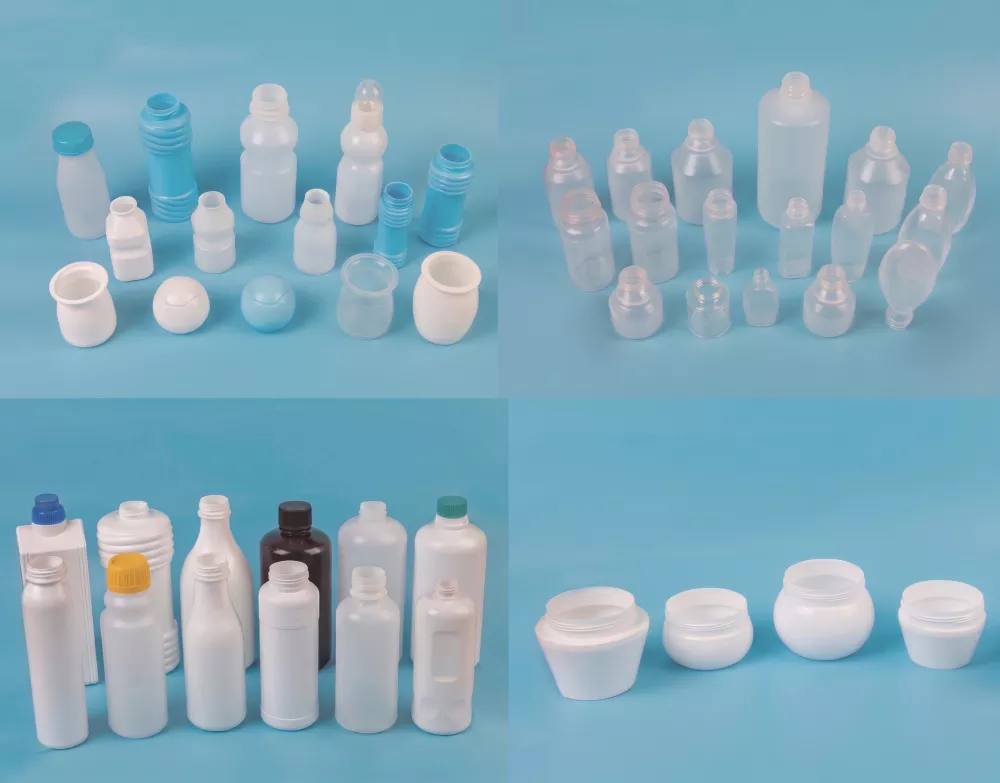
IBM is not a lesser technology than ISBM — for certain applications it is the better choice:
IBM can run multi-layer (coinjection) structures using separate injection units for core and skin layers. ISBM is generally single-layer because the stretch process would delaminate most coinjection structures.
HDPE cannot be stretch-blow molded (it crystallises rapidly and has no orientation window). IBM is ideal for HDPE eye drop bottles, nose spray bottles, and other HDPE containers requiring injection-quality necks.
Containers below 5ml volume (sterile vials, sample containers, unit-dose packaging) are challenging for ISBM because preform wall thickness becomes very small relative to gate dimensions. IBM handles these sizes reliably.
IBM tooling can accommodate 6, 9, or 12 cavities for very small containers, achieving very high output rates for mini vials and ampoule replacements at lower capital cost than comparable ISBM configurations.
Where ISBM Has the Advantage Over IBM
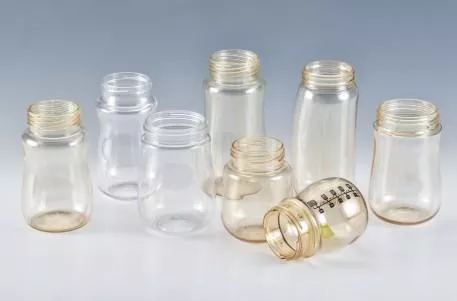
For most new packaging development projects where the container is a primary structural or barrier element, ISBM is the superior technology. Our ISBM machine range is specifically engineered to maximise orientation performance across PET, PP, and PETG applications.
Biaxial orientation allows 30–50% wall thickness reduction versus IBM for equivalent strength. At scale, this directly reduces material cost per container and reduces packaging weight for sustainability goals.
Oxygen and CO2 permeability is 30–60% lower in ISBM PET versus IBM PET at comparable wall thickness. For juice, wine, pharmaceutical, or any oxygen-sensitive product, this is shelf-life-critical.
ISBM PET and PETG deliver a water-clear gloss finish that is difficult to match with IBM, which tends to produce a slight milkiness in PET at heavier wall sections.
ISBM can efficiently produce bottles from 50ml to 5L. IBM becomes increasingly expensive and less practical above approximately 500ml due to parison weight and the absence of orientation to maintain wall integrity at larger sizes.
Decision Framework: ISBM or IBM?
| Scenario | Recommendation | دلیل |
|---|---|---|
| PET bottle 50ml–5L, general use | آی اس بی ام | Superior barrier, lightweighting, clarity |
| PET or PETG cosmetic bottle with complex geometry | آی اس بی ام | One-step ISBM handles complex geometries with conditioning flexibility |
| HDPE eye drop bottle or nose spray (small volume) | آیبیام | HDPE cannot be stretch-blown; IBM processes HDPE reliably |
| Multi-layer barrier container (EVOH core layer) | IBM (coinjection) | Coinjection IBM enables multi-layer walls; ISBM stretch would delaminate |
| PP pharmaceutical jar, wide mouth | ISBM or IBM | ISBM if clarity and lightweighting needed; IBM if thick-walled and barrier is not primary |
| Perfume bottle (small volume, complex shape, clarity critical) | ISBM (PETG) | ISBM PETG delivers glass-like clarity and geometric freedom |
| Sterile pharmaceutical ampoule replacement (very small volume) | آیبیام | IBM handles sub-5ml containers reliably; ISBM preform walls too thin |
For detailed guidance on the right machine technology for your application, our engineering team can evaluate your container design, material, and production volume to recommend the optimal process. Contact us for a technology selection consultation. You can also compare our ISBM machine range with available IBM models to understand the full product portfolio.
سوالات متداول
Can an ISBM machine be modified to run as an IBM machine (without the stretch rod)?
Can IBM produce bottles with the same clarity as ISBM?
Is IBM or ISBM better for pharmaceutical containers?
Which process has lower tooling cost — ISBM or IBM?
ISBM or IBM — Not Sure Which Is Right for Your Container?
Tell us about your container design, material, volume, and application — we will recommend the right technology and give you an indicative machine specification.