
¿Qué es la orientación biaxial en ISBM y por qué es importante?
La orientación biaxial es el fenómeno de ingeniería molecular que hace que los envases moldeados por inyección-soplado sean tan superiores a los producidos mediante otros métodos de moldeo por soplado. Cuando los ingenieros de embalaje especifican el moldeo por inyección-soplado en lugar del moldeo por extrusión-soplado o el moldeo por inyección-soplado para una aplicación exigente, la orientación biaxial es casi siempre la principal justificación técnica. Sin embargo, el mecanismo se describe con frecuencia en términos vagos —«las cadenas de polímero se alinean»— sin la profundidad práctica necesaria para comprender por qué los parámetros de procesamiento deben controlarse con tanta precisión, o por qué desviarse del rango de orientación produce envases defectuosos.
Esta guía explica la orientación biaxial desde los principios básicos: qué sucede a nivel molecular y microestructural, cómo la induce la máquina ISBM, cómo los parámetros de relación de estiramiento controlan su magnitud y cuáles son las consecuencias de ingeniería para el rendimiento del contenedor terminado.
¿Qué es la orientación biaxial? — Una definición molecular
En un polímero no orientado (amorfo o isotrópico), las moléculas de cadena larga adoptan configuraciones de ovillo aleatorio sin una dirección preferida. El material presenta las mismas propiedades en todas las direcciones: es isotrópico. Cuando este material se deforma mecánicamente a una temperatura superior a su temperatura de transición vítrea (Tg) pero inferior a su temperatura de fusión (Tm), las cadenas se ven obligadas a desenrollarse y alinearse preferentemente en la dirección de la fuerza aplicada.
Cuando la deformación se produce simultáneamente en dos direcciones perpendiculares, las cadenas se alinean en un plano; esto se denomina orientación biaxial. El polímero deja de ser isotrópico y presenta propiedades mecánicas, de barrera y ópticas mejoradas en las dos direcciones orientadas, con una correspondiente reducción de esas mismas propiedades en la dirección transversal.
- Debajo de Tg: El polímero es vítreo: las cadenas están congeladas, no pueden orientarse y la deformación provoca una fractura frágil.
- Entre Tg y Tcc (temperatura de cristalización en frío): La “ventana de orientación”: las cadenas son móviles, pueden alinearse y bloquearse en la orientación.
- Por encima de Tcc: Se desarrolla una cristalinidad fría incontrolada: turbidez, rigidez, pérdida de capacidad de soplado.
- En Tm: Estado de fusión: se pierde toda la orientación, las cadenas se vuelven a aleatorizar.
Cómo se desarrolla la orientación biaxial durante el ISBM
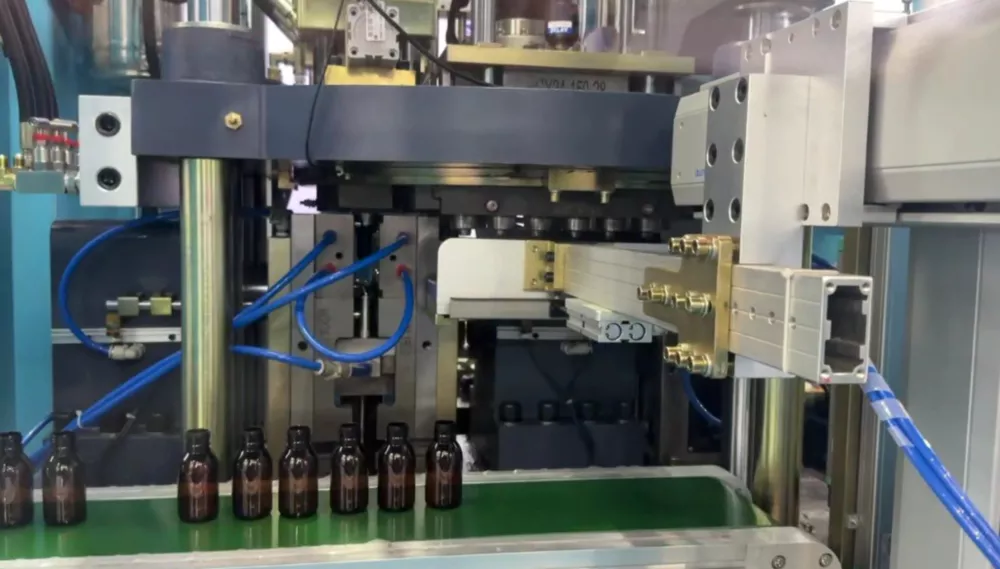
En el proceso ISBM, la orientación biaxial se diseña deliberadamente mediante la acción coordinada de dos deformaciones simultáneas en la estación de estirado y soplado:
↕ Estiramiento axial (dirección de la máquina)
La varilla de estiramiento desciende a través del cuello de la preforma a una velocidad controlada, alargando físicamente el cuerpo de la preforma en la dirección vertical (axial). Esta fuerza se aplica al polímero mientras se encuentra dentro del rango de temperatura de orientación. Las cadenas se alinean preferentemente en la dirección axial. La magnitud de este estiramiento se cuantifica como la relación de estiramiento axial (ASR) = longitud final del cuerpo de la botella ÷ longitud del cuerpo de la preforma. Para el PET, una ASR objetivo típica es de 2,5 a 3,5×.
↔ Expansión radial (dirección circunferencial)
El aire comprimido infla la preforma hacia afuera contra las paredes del molde de soplado, expandiendo el diámetro en la dirección circunferencial (anillo). Esto crea una orientación perpendicular a la dirección de la varilla de estiramiento. La relación de estiramiento anular (HSR) = diámetro final del cuerpo de la botella ÷ diámetro del cuerpo de la preforma. Para el PET, la HSR objetivo suele ser de 3,0 a 4,0×. El producto de ASR y HSR da la relación de estiramiento biaxial (BSR = ASR × HSR), que normalmente debería ser de 8 a 12× para una orientación óptima del PET.
Estas dos deformaciones no son simplemente aditivas, sino que interactúan sinérgicamente. La disposición de las cadenas de PET con orientación biaxial crea una microestructura semicristalina con cristalitos orientados incrustados en una matriz amorfa orientada. Esta estructura es responsable de la excepcional combinación de propiedades que convierte al PET en el material dominante para el embalaje ISBM.

Cristalinidad inducida por tensión en PET: un caso especial.
El PET presenta un fenómeno denominado cristalinidad inducida por deformación (SIC), también conocida como cristalización inducida por tensión, que resulta único y fundamental para su rendimiento en aplicaciones ISBM. En condiciones normales de procesamiento térmico, el PET cristaliza lentamente; la cinética de cristalización a temperaturas de estiramiento-soplado (90-105 °C) es relativamente lenta. Sin embargo, cuando las cadenas de PET se deforman rápidamente en la estación de estiramiento-soplado, la energía mecánica de la deformación acelera drásticamente la cristalización: las cadenas se alinean y cristalizan casi instantáneamente durante el estiramiento.
La cristalinidad desarrollada de esta manera es fundamentalmente diferente de la cristalinidad térmica: los cristales son muy pequeños (a escala nanométrica), altamente orientados y distribuidos por toda la matriz en lugar de crecer como grandes esferulitas. Esta fina estructura cristalina orientada:
- Dispersa mínimamente la luz; la botella permanece ópticamente transparente a pesar de ser parcialmente cristalina.
- Crea enlaces cruzados físicos que aumentan la rigidez y reducen la deformación.
- Reduce significativamente la permeabilidad de los gases al crear una trayectoria de difusión tortuosa para las moléculas de gas.
- Aumenta la resistencia térmica efectiva por encima de la del PET amorfo.
El grado de SIC está directamente relacionado con la relación de estiramiento y la velocidad de deformación. Por eso, la optimización de la relación de estiramiento no se trata simplemente de alcanzar un objetivo dimensional, sino fundamentalmente de diseñar una microestructura específica con propiedades específicas.
Por qué importa la orientación biaxial: Beneficios cuantificados para la propiedad
| Propiedad | Película de PET no orientada | Pared de botella de PET con orientación biaxial | Mejora |
|---|---|---|---|
| Resistencia a la tracción | ~50 MPa | ~150–200 MPa | 3–4 veces mayor |
| permeabilidad al O₂ | Base | 30–50% inferior | Importante para zumos/productos farmacéuticos |
| barrera de CO₂ | Base | 40–60% reducción en la tasa de permeación | Fundamental para la vida útil de los refrescos |
| Resistencia al impacto (caída) | Fractura frágil común | Deformación dúctil; resiste la rotura. | Imprescindible para la seguridad del consumidor. |
| Claridad óptica (neblina) | Bajo-moderado (crecimiento lento de los cristalitos) | Muy poca turbidez (cristalitos finamente orientados) | Estética premium |
| Espesor de pared necesario | Base | 30–50% pared más delgada para el mismo rendimiento | Reducción importante de los costos de materiales |
La ventana de orientación: cómo aplicarla correctamente en la práctica.
El rango de temperatura dentro del cual se puede inducir con éxito la orientación biaxial depende del material y es relativamente estrecho. Operar fuera de este rango produce defectos característicos:
- Realizar desgarros durante el estiramiento
- Se requiere una presión de soplado muy alta, riesgo de rebabas en el molde.
- Mala distribución del espesor de la pared: fondo grueso, pared lateral delgada.
- El tiempo de ciclo de la máquina aumentó mientras el operador realizaba ajustes.
- Deformación biaxial suave y controlada
- Se desarrolla cristalinidad inducida por deformación.
- Distribución uniforme del espesor de la pared
- Claridad cristalina, buena barrera, excelente resistencia a las caídas.
- El rendimiento es demasiado suave: sopla de forma irregular.
- Perla / neblina debida a cristalinidad fría no controlada
- Distorsión del mástil (especialmente en PP de un solo paso)
- Propiedades mecánicas reducidas a pesar del intento de orientación
| Material | Tg (°C) | Ventana de soplado óptima (°C) | Objetivo BSR | ¿SIC? |
|---|---|---|---|---|
| MASCOTA | ~75°C | 90–105 °C | 8–12× | Sí, mecanismo principal de construcción de propiedades |
| PP (copolímero aleatorio) | ~0°C (Tm ~145–165°C) | 125–140 °C (estrecho) | 4–7 veces | Limitado: orientación principalmente amorfa |
| PETG | ~81°C | 90–100 °C | 6–9× | No, es completamente amorfo. |
Consecuencias de la suborientación o sobreorientación
Tanto la orientación insuficiente como la excesiva producen problemas. Una orientación insuficiente —generalmente debido a relaciones de estiramiento demasiado bajas, una preforma demasiado fría o una velocidad de la varilla de estiramiento inadecuada— da como resultado una botella que tiene un aspecto aceptable pero un rendimiento deficiente en su uso:
- Menor resistencia a la carga superior: la botella se aplasta con una fuerza de apilamiento menor.
- Mayor permeabilidad a los gases: menor vida útil para productos carbonatados o sensibles al oxígeno.
- Mayor deformación por fluencia bajo carga sostenida: la botella se deforma en una pila de palés con el tiempo.
- Resistencia reducida al impacto: las botellas se rompen en la prueba de caída en lugar de deformarse.
La sobreorientación —debido a relaciones de estiramiento demasiado altas, que normalmente producen valores BSR por encima de la meseta de entrelazamiento de la cadena del material— provoca:
- Estrés blanqueamiento y agrietamiento, particularmente alrededor de la zona de la puerta.
- Material de base muy delgado en la puerta que provoca fallas en el campo.
- Fibrilación: las cadenas se separan paralelamente a la dirección de orientación bajo impacto.
Cómo verificar la calidad de la orientación en la producción
La calidad de la orientación no se puede medir directamente en línea con simples calibres, pero varias comprobaciones prácticas de producción confirman que el proceso cumple con las especificaciones. Nuestras máquinas ISBM Estos métodos de verificación se respaldan mediante sistemas de control de parámetros de precisión:
| Método de prueba | Lo que revela | Frecuencia |
|---|---|---|
| Medición del espesor de la pared (gravimétrica/ultrasónica) | Distribución del estiramiento: indicador de orientación indirecta | Primer artículo + muestra por hora |
| Prueba de aplastamiento por carga superior | Integridad estructural general: orientación y espesor de pared combinados. | Cada lote comienza |
| Prueba de caída (lleno, 1,2 m) | Resistencia al impacto: calidad de orientación biaxial | Cada lote comienza + cambia |
| birrefringencia de luz polarizada | Medición directa del grado de orientación y la uniformidad. | Investigación y desarrollo / Calificación de nuevos productos |
| DSC (Calorimetría Diferencial de Barrido) | Cristalinidad %: cuantifica la cristalización inducida por tensión. | Validación / investigación del problema |
| Medición de la bruma (ASTM D1003) | Transparencia óptica: confirma la ausencia de cristalinidad incontrolada. | Cada lote para envases de grado óptico |
Para preguntas sobre cómo configurar y verificar su proceso ISBM para lograr una orientación biaxial consistente, Contacta con nuestro equipo de ingeniería de procesos.Proporcionamos asistencia para la configuración del proceso y documentación de parámetros para todos los modelos de máquinas.
Preguntas frecuentes
¿La orientación biaxial hace que la pared de la botella sea más resistente en todas las direcciones?
¿La orientación biaxial es permanente o se relaja con el tiempo?
¿Por qué es más difícil orientar biaxialmente el PP que el PET en ISBM?
¿Se puede utilizar la orientación biaxial para reducir el peso de la botella?
¿Cómo se relaciona la relación de estiramiento biaxial con el diseño de la preforma?
Optimice su proceso ISBM para una máxima orientación.
Nuestros ingenieros de procesos pueden revisar la configuración actual de la relación de estiramiento, el diseño de la preforma y el perfil de temperatura para mejorar el rendimiento de la botella y reducir el consumo de material.
Solicitar una revisión del proceso
Ver especificaciones de la máquina ISBM